

On this page5 sections
What is a leisure battery?
A Go-Pod leisure battery is designed to provide steady 12V power over a longer period, helping to run caravan systems when you are not connected to mains electricity.
This is different from a car battery, which is built to deliver a short burst of high power to start an engine. Leisure batteries are often called deep cycle batteries because they are made for repeated discharge and recharge cycles.
Why maintenance matters
Letting a leisure battery run too low or leaving it discharged for long periods can shorten its life. Simple checks and regular charging help keep it healthier.
Car battery vs leisure battery
They are both batteries, but they are built for different jobs. Tiny detail, big difference.
Car battery
Short burst
Designed to start an engine with a quick hit of power.
Leisure battery
Steady supply
Designed to power 12V caravan systems over time.
How to check your leisure battery

There are two useful ways to check your Go-Pod leisure battery charge level: a quick check using the Sargent control panel, or a more accurate voltage reading using a multimeter.
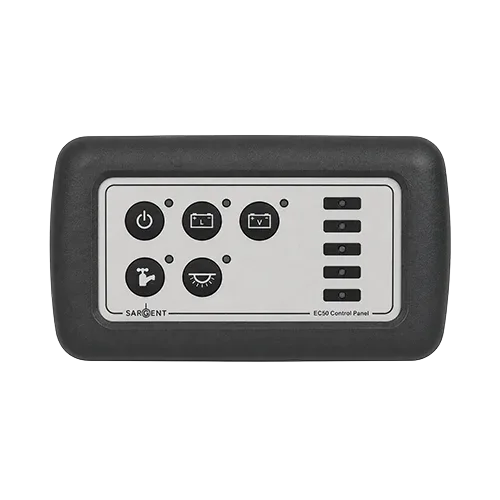
Use the control panel
Press the battery icon button with an “L” inside. The LEDs on the right-hand side of the panel will illuminate to show the current leisure battery charge level.
Useful when you do not have a multimeter nearby
Good for a quick glance, but not the most accurate method
If the leisure battery drops below 9V, the red LED at the bottom will illuminate, an alarm will sound for 1 minute, and power will automatically switch off.
Use a multimeter
For a better voltage reading, switch off appliances and systems, make sure the control panel is not switched on, and do not test while connected to mains hook-up.
Step 1
Locate the leisure battery under one of the seats and remove the battery box cover.
Step 2
Set the multimeter to DC voltage, usually shown by a solid and dashed line above V.
Step 3
Set the dial to the 20V range so it can measure between 0V and 20V.
Step 4
Place red on positive + and black on negative -, then read the voltage on the display.
A fully charged battery should usually read around 12.6V to 12.7V after resting.
Let the battery rest before testing
For the most useful reading, allow the battery to rest for at least 1 hour, ideally 24 hours. Do not test while it is charging from mains hook-up or tow electrics, as this can give an inaccurate voltage reading.
What your battery voltage means
Once the battery has rested and is not being charged, a multimeter reading gives you a useful guide to the approximate state of charge.
A fully charged leisure battery should usually read around 12.6V to 12.7V. If it is reading 12.4V or below, it is time to recharge rather than leaving it discharged.
Do not test while charging
Testing while connected to mains hook-up, solar input or tow electrics can make the reading look higher than the battery’s true resting voltage.
Approximate charge guide
Use these figures as a general guide after the battery has rested.
| Voltage | Approximate charge | Action |
|---|---|---|
| 12.7V+ | 100% | Fully charged |
| 12.5V | 75% | Good charge |
| 12.4V | 50% | Recharge soon |
| 12.2V | 25% | Low charge |
| 12.0V or less | Discharged | Charge immediately |
Caring for your battery

It’s advisable to perform maintenance of your battery at least annually, but ideally once every few months. For your peace of mind, check the battery level before you go away in your Go-Pod and perform a visual inspection of the battery box and terminals.
Clean the tray and terminals
You should clean the battery tray annually, removing any dirt or debris, and apply a thin film of petroleum jelly or vaseline to the terminals.
This helps to protect them from rust and ensures greater longevity of your battery.
Charge during storage

When your Go-Pod is not in use for a month or longer (if it’s in storage over winter, for example) you should try to fully charge the battery at least once a month to prevent degradation. If a battery is allowed to drop below 40% charge, sulphation can occur which damages the battery and reduces the overall capacity. In the worst cases, sulphation can render a battery useless and require replacement.
Solar and recharging

If your Go-Pod has a solar panel installed on the pop-top roof, this will help to maintain the charge level, but the amount of power provided by the solar panel will vary greatly depending on its exposure to sunlight. In the winter months, this will be far less due to shorter daylight hours, overcast conditions and reduced strength of sunlight.
Use this as a practical owner guide
This page is intended to help Go-Pod owners understand basic leisure battery maintenance, charging habits and voltage checks.
It is not a replacement for official equipment manuals, professional electrical advice, or inspection by a qualified caravan technician if something is not working as expected.
Battery and electrical safety

If your leisure battery is not charging, draining quickly, overheating, producing unusual smells, or if electrical equipment behaves unexpectedly, stop using the system and ask a qualified caravan technician for advice.
Use suitable caravan electrical equipment and cables
Do not attempt electrical repairs unless qualified
Follow the relevant manuals for your fitted equipment
Keep learning about your Go-Pod electrics
For more help, read the full charging guide or learn how to use the Go-Pod control panel.